Rope Engineering
Belts vs Ropes: Lift Suspension Compared Honestly
In brief Modern machine-room-less lifts increasingly hang on polyurethane-coated steel belts instead of round wire ropes: belts allow much smaller drive pulleys and compact gearless machines, run quietly, and need no lubrication — but their steel cords are hidden inside the coating, so condition cannot be judged by eye and replacement follows platform-specific indicators and criteria. Neither technology is simply “better”; they wear differently, are inspected differently, and both eventually need planned replacement by people who know the platform.
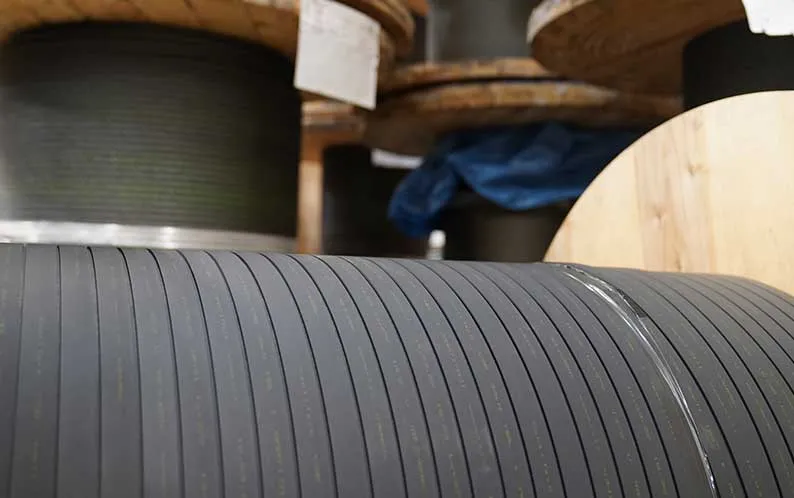
Walk two identical-looking lifts in the same building and you may find them hanging on entirely different centuries: one on stranded steel wire ropes — the technology that made tall buildings possible — the other on flat polyurethane belts with steel cords inside, the technology that deleted the machine room. Owners now manage both, often side by side, and the practical questions are the same: how does it wear, how do we know, and what does replacement look like?
Why belts happened
The wire rope’s one stubborn constraint is bending. A stranded rope needs generous sheave diameters to keep bending stress survivable — the traditional design ratio between sheave and rope diameter is what makes traction sheaves, and the machines that turn them, physically big.
Flatten the load-bearing steel into a ribbon of small-diameter cords inside a polyurethane jacket and that constraint collapses. Belts run happily over small pulleys, which permit compact high-torque gearless machines, which fit inside the shaft headroom — and the machine room disappears from the architect’s floor plan. Add quiet running (polymer on steel, no metal contact) and zero field lubrication, and the appeal to modern construction is obvious.
Nothing is free: the same jacket that protects the cords conceals them, pulley alignment tolerances tighten (flat belts track less forgivingly than grooved ropes), and suspension becomes more platform-specific — belts, clamps and terminations are families matched to particular drive systems, not commodity constructions.
How each one wears
Ropes wear observably. Crown wires abrade and fatigue where the rope bears on the groove; diameter shrinks; broken wires appear and are countable; rouging reports internal fretting. The whole discard framework is built on a century of reading these visible, measurable signs. Ropes also demand their tribute: lubrication management, groove condition, tension equalisation.
Belts wear covertly. The steel cords fatigue over every pulley passage exactly as rope wires do — but behind the jacket. What shows is secondary: jacket cracking and glazing, wear stripes from a misaligned pulley, edge fray from tracking contact, coating shed collecting below. Several platforms compensate with electrical condition monitoring through the cords themselves — resistance-based supervision that flags cord degradation — and manufacturers publish platform-specific inspection indicators and discard criteria. Belt assessment is therefore a procedure-literate activity: knowing what this platform shows, measures and permits.
The failure logics converge on one principle: both are consumed by cycles, and both are replaced on evidence. The difference is where the evidence lives — on the surface of a rope, in the indicators and monitoring of a belt.
What replacement involves
Re-roping is the mature trade: survey the system (ropes, grooves, tensions, terminations), machine or replace worn sheaves, fit certified ropes, equalise, document — the discipline this whole method is built on.
Re-belting is the same logic in a newer dialect: platform identified, belt family and rating matched, pulleys assessed for wear and alignment (the belt-world equivalent of groove gauging — worn or misaligned pulleys destroy new belts just as faithfully), belts fitted and tensioned to the platform’s procedure, terminations and monitoring reconnected, and commissioning checks completed. Alignment and tensioning discipline decide the new set’s life, exactly as grooves and equalisation do for rope.
For owners the strategic point is independence reaching belts. Belted platforms concentrated suspension work back with OEMs for years; compliant belts and competent independent works now restore choice on the common platforms. Where a platform is genuinely locked, the honest report says so — but “belted” no longer automatically means “captive”.
Choosing, and living with the choice
Nobody re-ropes a lift into a belted one or vice versa on a whim — suspension technology is set by the installed platform. The real decisions are lifecycle ones:
- Roped installations reward classical stewardship: surveys that measure, grooves that get gauged, tensions that get equalised. Their virtue is transparency — everything that matters can be seen or measured with standard practice.
- Belted installations reward procedure discipline: platform-correct inspection, respect for manufacturer indicators, pulleys treated as seriously as belts.
- Mixed portfolios reward a partner fluent in both, so condition reporting, planning and documentation arrive in one consistent stream.
Re-Ropes surveys and replaces both — the name says ropes, the method (survey, supply, fit, guarantee) never cared what shape the steel was. Tell us what your lifts hang on and we’ll survey it honestly.
Frequently asked questions
Do suspension belts last longer than ropes?
Manufacturers generally project long service lives for belts, and freedom from external abrasion and corrosion-through-lubrication-loss helps. But belts still fatigue — the steel cords inside flex over every pulley passage — and jackets age, crack and shed. The honest answer is that both technologies are consumed by duty; belts simply hide the consumption better, which makes disciplined inspection more important, not less.
How is a belt inspected if the cords are invisible?
Through what can be seen and measured — jacket condition (cracking, wear-through, discolouration at pulley contact), dimensional checks, pulley alignment and wear — plus platform-specific means: several OEM systems monitor belt condition electrically through the cords, and service history and cycle counts feed the assessment. Where indicators disagree, the conservative call wins, exactly as with rope discard.
Can belts be replaced by someone other than the original manufacturer?
Often yes — compliant belts exist for common platforms and independent re-belting is routine on them, restoring choice to owners on maintenance and price. Some platforms remain genuinely proprietary. Our practice is to identify the platform, state plainly whether independent supply is available, and where it is, re-belt with correct procedure, tensioning and documentation.
My building has both belted and roped lifts — does that complicate maintenance?
Only if your suppliers only speak one language. The lifecycle logic is identical — survey condition, plan replacement, fit correctly, certify — and a specialist covering both means one survey programme, one standard of documentation and one accountable relationship across the portfolio, whichever way each lift happens to hang.