Compliance & Duty Holders
LOLER, Lift Ropes and You: A Duty Holder’s Guide
In brief Under LOLER 1998, lifts used to carry people at work must receive a thorough examination by a competent person at least every 6 months (12 months for goods-only lifts, or per an examination scheme), and suspension ropes are core to that examination. The report may specify timescales for remedying defects; serious defects must be reported to the enforcing authority. SAFed LG1 guides the supplementary tests a competent person may specify. When a report flags ropes, the practical next step is a measured rope survey that converts the examiner’s flag into a scoped, priced decision.
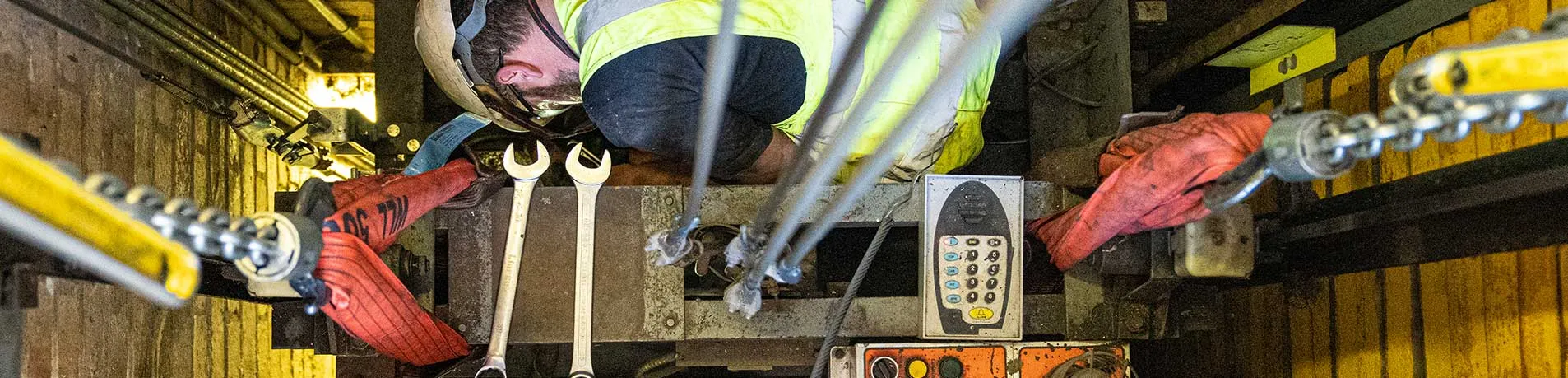
If you own, manage or control a building with a passenger lift, the law has already appointed you to a role: duty holder. The Lifting Operations and Lifting Equipment Regulations 1998 (LOLER) do not care whether lifts are your speciality — they require that lifting equipment used at work is thoroughly examined at intervals, that reports are acted on, and that records are kept. This guide covers the rope-shaped part of that duty in plain terms.
What LOLER actually requires
The essentials for lifts in workplaces:
- Thorough examination at least every 6 months for lifts used to carry people (and lifting accessories); every 12 months for goods-only lifts — or at intervals set by an examination scheme drawn up by a competent person. Examinations are also required after installation, after substantial modification, and after events liable to affect integrity.
- A written report from the competent person, identifying defects and — where a defect could become a danger — the timescale within which it must be remedied.
- Serious defects notified: defects involving an existing or imminent risk of serious injury are reported by the competent person to the duty holder and the enforcing authority (HSE or local authority). A lift with such a defect must not be used until it is remedied.
- Records retained and available to the examiner.
Residential-block lifts sit in a nuance: LOLER applies to workplace lifting equipment, but landlords and managing agents owe equivalent duties under the Health and Safety at Work Act and common practice is to examine domestic passenger lifts to the same 6-monthly regime. In Ireland, equivalent duties arise under S.I. No. 299/2007 with periodic thorough examination of people-carrying lifts.
Why ropes headline the examination
The suspension system is where the examination earns its keep: ropes are the components that are designed to wear out in service. A competent person examining a lift gives particular attention to broken wires, diameter loss, corrosion, lubrication state, termination condition, equality of tension, and the sheave grooves the ropes run in — the same indicators covered in our discard signs guide.
Examination language is worth decoding. Reports rarely leap from “good” to “replace immediately”; they escalate through observation notes — “ropes showing signs of wear, monitor”, “rope condition deteriorating, recommend specialist assessment” — before becoming timescaled defects. Each step is the competent person telling the duty holder to start the decision process now, while the options are still cheap.
The gap the duty holder falls into
Here is the structural problem LOLER leaves you with: the competent person identifies the condition but does not fix it (independence is the point of the role), and the maintenance contract often excludes ropes as a capital item. The result: a flagged report, a lift that still runs, and nobody obviously owning the next move. Reports pile up saying “monitor”; then one says “defect — remedy within 28 days”, and suddenly it is an emergency procurement on a component with a manufacturing lead time.
The escape is cheap and boring: on the first flag, commission a measured rope survey. Ours are free and independent of any maintenance contract. The survey quantifies what the examiner flagged — counts, measurements, groove condition, tension spread, photographs — and delivers a written answer: either no action justified yet, re-survey at N months (which also gives you a documented basis for continuing), or replacement recommended, here is the scope, price and programme. Either way, the duty holder is back in control of the timeline. That is the whole game: planned re-roping is a scheduled day; forced re-roping is downtime, premium pricing and an unhappy building.
Supplementary tests and SAFed LG1
Thorough examination is primarily examination — but LOLER reg 9 lets the competent person specify supplementary tests where they judge them necessary. The Safety Assessment Federation’s LG1 (Guidelines on the Supplementary Tests of In-Service Lifts) is the industry’s reference for what those tests look like on in-service passenger lifts and when each is appropriate.
For the duty holder the practical points are: the competent person decides whether and what; the tests are additional to, not instead of, the 6-monthly examinations; and when tests are specified, you need competent hands to prepare for and support them. That support — roping condition work, tension equalisation, component renewal beforehand, works attendance — is exactly where Re-Ropes slots in, with the WH Scott Group’s accredited inspection capability behind us.
The paperwork that protects you
When roping work is done, the documentation is not ceremony — it is the duty holder’s evidence chain: certificates for every rope and chain supplied, confirmation of the works completed, and site sign-off. It is what your next thorough examination expects to see, what your insurer’s engineer respects, and what transfers cleanly when the building changes hands. Every Re-Ropes job closes with that file emailed to you, and the guarantee on record.
Report flagged the ropes? Send it to us with the lift details — we’ll survey, measure and give you the straight answer, including “not yet” when that’s what the numbers say.
Frequently asked questions
Is a thorough examination the same as lift maintenance?
No — they are legally and practically distinct. Maintenance (under PUWER and good practice) keeps the lift running; the thorough examination is an independent, periodic inspection by a competent person to verify the lift is safe to continue in use, feeding a written report to the duty holder. One does not substitute for the other: a well-maintained lift still needs its examinations, and an examination is not a service visit.
Who is the competent person for LOLER purposes?
Someone with the appropriate practical and theoretical knowledge and experience to detect defects and assess their importance — in practice usually an engineer-surveyor from a specialist inspection body, often an insurer-linked or SAFed-member organisation, independent of the maintenance contractor. Re-Ropes is not the competent person: we are the roping specialists whose surveys and works support what the competent person requires.
The examination report says “ropes worn — monitor”. What now?
Treat it as the start of a decision, not an instruction to wait. A measured rope survey — broken wire counts, diameter measurements, groove gauging, tension comparison — establishes how far wear has progressed and how fast, turning "monitor" into either a documented clean bill or a scoped replacement with a timescale you can budget. Duty holders who survey on the first flag almost never face emergency re-ropes.
What are supplementary tests under SAFed LG1?
LOLER regulation 9(3)(a)(ii) allows the competent person to specify tests as part of thorough examination where they judge them necessary. SAFed’s LG1 guidance describes the tests used on in-service lifts and when they are appropriate. If your competent person specifies such tests, they will define the scope; Re-Ropes provides the roping expertise and works that support the process, with the WH Scott Group’s accredited inspection capability behind us.