Rope Engineering
Choosing Lift Rope: 8×19, Cores and Grades Decoded
In brief A lift rope designation like 8×19 Seale FC 1370/1770 U sZ is a complete engineering recipe: 8 strands of 19 wires in Seale pattern, fibre core, dual-tensile wire grades, uncoated bright wire, right-hand ordinary lay. Each element trades flexibility, wear resistance, stretch and sheave-friendliness against the others — which is why substitution isn’t order-picking, and why the designation on the certificate must match the duty, not just the diameter.
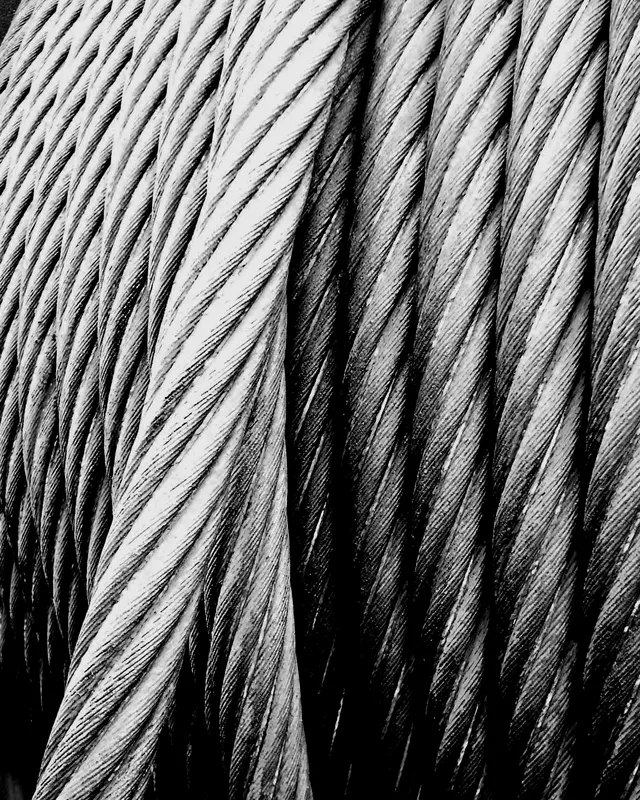
Somewhere on the certificate of every rope we ship is a line of code: 8MM F819 8×19 S-NFC 1370/1770 U sZ. To most people it is inventory noise. To a rope engineer it is the entire behaviour of that rope in service, compressed into one line — how it will ride, wear, stretch, grip and age. Since designations like this decide multi-decade outcomes, they are worth being able to read.
8×19: the shape of the trade
The first pair of numbers is the construction: strands × wires per strand. The lift industry’s centre of gravity is 8×19 — eight strands of nominally nineteen wires each, laid around a core.
Why eight? Flexibility and contact. Against the 6×19 family that dominates general wire rope, eight thinner strands make a rounder, more conformable rope: it bends over sheaves more willingly and presents a larger, gentler contact arc to the groove. For a machine whose entire working life is bending over sheaves inside a building full of people who can hear it, those virtues — sheave-friendliness and quietness — is why the lift trade standardised on it. The trade-off is a slightly lower metallic fill (less steel in the same circle), paid for with the strand pattern and grades.
The “19” is a family, not a census — the pattern of those wires is the next code element.
Seale and Warrington: how the 19 are arranged
Wires in a strand are not scattered; they are laid in engineered layers, and the layer geometry has a name:
- Seale (S) — 9 large outer wires over 9 small inners over a king wire (9-9-1). Fat outer wires mean maximum metal where the groove abrades — the wear-resistant pattern, the standard choice where grooves are the enemy.
- Warrington (W) — outer layer alternates large and small wires (typically 6+6/6/1). More, finer contact points make the strand more flexible and fatigue-tolerant in bending, at some cost in abrasion life.
- Filler and combined patterns appear in high-performance constructions, packing more steel into the circle — the route the PAWO F-series takes for high-duty installations.
Seale where abrasion governs, Warrington where bending fatigue governs — and the installation’s sheave sizes, speeds and duty decide which governs.
FC or IWRC: the heart of the matter
Inside the strands sits the core, and the core is the biggest single behavioural choice in the designation:
Fibre core (FC/NFC/SFC — natural or synthetic). The classical lift rope heart: sisal or polypropylene, resilient and lubricant-holding. It cushions the strands, feeds stored lubricant outward through service, and gives the rope its famously supple, quiet character. Its costs: it compacts — fibre-core ropes show the most constructional stretch — and it offers modest support against crushing in heavily loaded grooves.
Steel core (IWRC — independent wire rope core). A small rope serving as the spine of the big one. Minimal stretch, strong crush resistance, higher breaking force for the same diameter, and tolerance of higher groove pressures — the natural partner for high-travel, high-duty and dual-tensile constructions like the PAWO F10 we stock by the tens of kilometres. Costs: stiffer bending, less stored lubrication, and less acoustic forgiveness.
Mixed cores (fibre-jacketed steel and similar hybrids) split the difference for constructions that want dimensional stability and some cushioning.
Core choice is where re-roping decisions most often upgrade: a high-travel installation that spent its life fighting stretch and shortening visits is a candidate for steel core the day the survey says so — deliberately, with traction and groove implications checked, not as a casual swap.
1370/1770: grades, and the dual-tensile trick
Wire tensile grades are quoted in N/mm². Lift practice runs mostly between 1370 and 1770, and the interesting designations carry two numbers. 1370/1770 means the outer wires — the ones that touch the groove — are drawn to the softer 1370 grade, while the hidden inner wires are 1770.
This is deliberate metallurgy for traction duty: soft outside, strong inside. Softer outer wires wear politely against cast-iron grooves (sacrificing themselves rather than the sheave) and polish in quietly; stronger inner wires supply the breaking force. Single-grade 1570 constructions split the difference for general duty. Harder isn’t better — harder outer wire is a sheave-eating choice unless the groove material and duty justify it.
U and sZ: the fine print that isn’t fine
U — uncoated (“bright”) wire, the standard indoors; galvanised variants serve damp environments. sZ decodes as: wires laid s (left) in the strand, strands laid Z (right) in the rope — opposite directions, which is ordinary (regular) lay. Ordinary lay’s virtue is that it is largely non-rotating under load and docile to handle — exactly what a suspension rope hanging a car on a free termination needs. (Lang lay, wires and strands laid the same way, wears better but tries to spin — its home is drums and guided duty, not lift suspension.) The lowly sZ is, quietly, a safety parameter.
Reading a real one
Back to the shelf: 8MM F819 8×19 S-NFC 1370/1770 U sZ — 8 mm diameter, 8×19 Seale, natural fibre core, dual-tensile 1370 outer / 1770 inner, bright wire, right-hand ordinary lay. Every element now tells you something: a supple, quiet, sheave-kind traction rope that will stretch noticeably as its fibre heart beds in, wear its soft crowns gracefully, and want its tensions equalised after the settling. Its steel-core siblings on the next reel — 8×19W-IWRC 1570 U sZ — trade the cushion for stability and duty.
Specification against standards (ISO 4344 for lift ropes, EN 12385-5 for stranded lift constructions) plus certificates tying each delivered length to its tested batch: that is the supply half of rope integrity. The other half — matching the recipe to the installation — is a conversation with people who read designations for a living. Ours is a phone call away; send the designation on your old certificate, or a sample, and we’ll confirm the match or engineer the equivalent.
Frequently asked questions
What does 8×19 mean on a lift rope?
Eight strands, each nominally of nineteen wires, laid around a core. Eight-strand constructions are the lift industry’s classic because they are more flexible and bed a larger contact arc into the groove than six-strand equivalents — kinder to sheaves and quieter in the shaft — at the cost of a slightly lower fill factor. The “19” describes the strand pattern family, most commonly Seale or Warrington arrangements.
Fibre core or steel core — which is better?
Neither — they answer different questions. Fibre cores (natural or synthetic) cushion the strands, hold lubricant reserve and give the classic quiet, flexible traction rope, but compact more (more constructional stretch) and offer less crush resistance. Steel cores (IWRC) stretch less, resist crushing and suit higher duties and dual-tensile constructions, but are stiffer and less forgiving of tight bending. High-travel and high-duty installations increasingly justify steel or mixed cores; modest traction duty is still well served by fibre.
What do the numbers 1370/1770 mean?
Wire tensile grades in N/mm². A single figure (e.g. 1570) means all load-bearing wires share that grade; a dual figure like 1370/1770 means the outer wires are the softer 1370 grade and inner wires the stronger 1770 — a deliberate design where softer outer wires wear gently against the sheave groove while stronger inner wires carry the load. Dual-tensile is the traction-rope compromise par excellence.
Can I substitute a different construction when re-roping?
Sometimes, and sometimes you should — but it is an engineering decision, not a catalogue swap. The replacement must satisfy the installation’s minimum breaking force and safety factor, suit the groove profile and sheave diameters, and behave acceptably in stretch and wear. Like-for-like is the default; upgrades (e.g. fibre to steel core on a high-travel lift with stretch problems) are made deliberately, with the traction and groove implications checked. This equivalence work is core to what our technical desk does daily.