Rope Engineering
Lift Rope Stretch: Why New Ropes Need Shortening
In brief New lift ropes always elongate in early service through constructional stretch: the helical strands and core bed down under load, permanently lengthening the rope — typically by a fraction of a percent for fibre-core constructions, less for steel-core. On a high-travel lift that fraction is real metres, consumed from counterweight runby. It is normal, predictable and managed by planned shortening (or re-termination) visits in the first months after fitting.
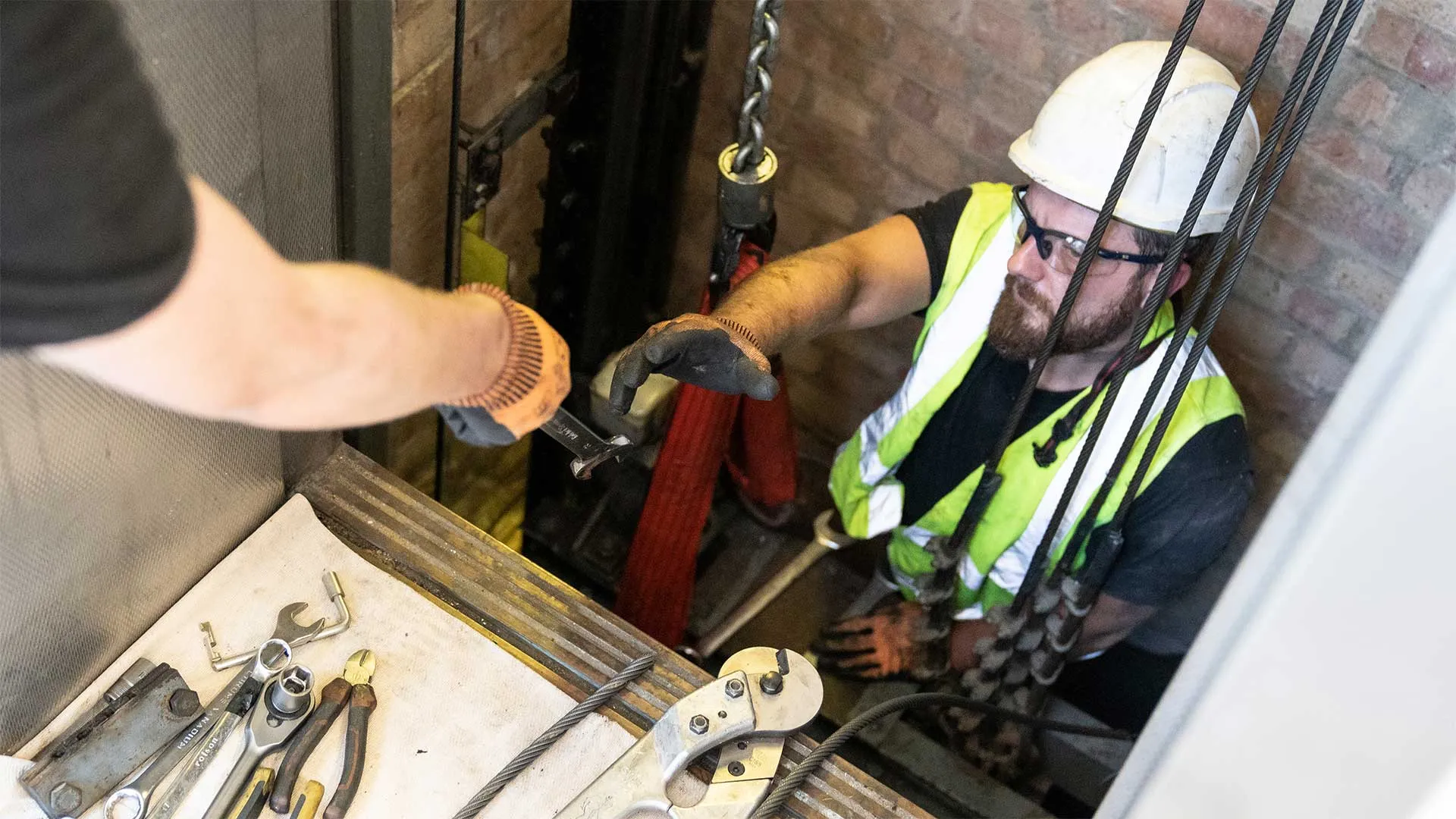
Fit a brand-new set of suspension ropes and, within weeks, they are longer than the set you measured. Nothing is wrong. The ropes are doing what every stranded steel rope has done since the trade began: bedding down. But on a lift — where the counterweight’s travel is finite and the margins are engineered — that elongation has to go somewhere, and managing it is part of a properly run re-roping programme.
Where the stretch comes from
A wire rope is not a solid bar; it is a helix of helices. Wires are laid into strands, strands are laid around a core, and everything is held in shape by geometry and tension. When a new rope takes load for the first time:
- strands seat more deeply into the core (especially fibre cores, which compact),
- wires within each strand settle against their neighbours,
- the lay angles tighten fractionally along the whole length.
The sum of all that micro-settlement is constructional stretch — a permanent elongation, front-loaded into early service: fastest in the first weeks, tailing off as the construction reaches its worked geometry. It is distinct from elastic stretch (the spring-like elongation under load that recovers when load is removed, present for the rope’s whole life) and from wear-related elongation late in life, where a failing core lets the construction keep lengthening — one of the discard signals.
Construction decides the magnitude. Fibre-core ropes — the classic 8×19 suspension constructions with natural or synthetic fibre hearts — settle the most, because the core itself compacts. Steel-core (IWRC) ropes settle least. This is a genuine selection consideration on high-travel installations: more on core choice in our guide to 8×19 constructions.
Why lifts care: the runby budget
Rope stretch on a crane pays out at the drum. On a traction lift there is no drum — car and counterweight hang on opposite ends of the same ropes, so every millimetre of elongation lowers the counterweight relative to the car. The design allows for this with counterweight runby: clearance between the counterweight and its buffers with the car at the top floor.
Stretch spends that clearance. On a low-rise lift with generous runby, a new set can often bed in without intervention. On a high-travel installation, do the arithmetic: 100 m of rope stretching a conservative 0.3–0.5% is 300–500 mm — typically more than the entire runby allowance. Unmanaged, the counterweight reaches its buffers while the car still has floors to serve.
The symptoms arrive in a recognisable order: levelling complaints at the top floors, then over-travel and safety-circuit faults, then — if truly neglected — the counterweight landing hard enough to shock-unload the ropes. Sudden unloading is how well-fitted ropes get damaged: slack rope can jump grooves, and the rebound can birdcage a rope in seconds.
Managing it: the shortening visit
Because constructional stretch is predictable, the management is simply scheduled follow-up:
- Measure at fitting. Runby recorded at handover — the baseline.
- Return in early service (site-specific; higher travel and fibre core mean sooner) to re-measure and shorten before the runby is consumed.
- Shorten at the terminations. Wedge sockets are re-made at corrected length; threaded terminals adjust where the design allows. This is a planned, per-rope operation — not a re-rope.
- Re-equalise tensions. Shortening changes load sharing across the set, so tensions are checked and balanced as part of the same visit (why equal tensions matter).
- Trend to stability. Once the rate flattens into the long, slow tail, the set goes back to routine survey intervals.
When we quote a supply-and-fit re-rope on a high-travel installation, the stretch programme is part of the conversation — the termination choice (wedge sockets make shortening fast and clean), the expected visit, and whose diary it goes in. That is the difference between stretch as an engineering parameter and stretch as an emergency.
The other stretch conversation: late life
One caution worth carrying: elongation is also a discard indicator. A rope that begins lengthening again years into service — after constructional stretch has long finished — is usually reporting core failure: the support structure collapsing and the construction extending as it degrades. That rope isn’t asking to be shortened; it is asking to be surveyed and replaced. Same symptom, opposite meaning, and the trend history is what tells them apart — another argument for measured surveys over snapshots.
Fitting new ropes soon, or fighting top-floor levelling on a set fitted last quarter? Talk to the works — we’ll measure, shorten and equalise before the runby budget runs out.
Frequently asked questions
Is rope stretch a sign of faulty ropes?
Almost never in early service. Constructional stretch is inherent to stranded rope — the geometry bedding down under load — and its magnitude and timing are broadly predictable by construction and duty. What would concern an engineer is stretch that continues accelerating long after bed-in, or sudden elongation late in life, which points to core deterioration rather than settlement.
How much will new lift ropes stretch?
As a working guide: natural-fibre-core constructions settle most, steel-core (IWRC) least, with mixed and synthetic cores between. The commonly used planning ranges are a fraction of a percent of rope length — but on 100 m of travel even 0.5% is half a metre, which is why high-travel installations plan shortening visits as part of the re-roping programme rather than as a surprise call-out.
What happens if stretched ropes are never shortened?
The counterweight loses runby and eventually lands on its buffers before the car reaches the top floor — showing up as levelling faults at the top, buffer strikes, or the safety circuit taking the lift out. Landing the counterweight also unloads the ropes suddenly, risking slack-rope conditions, rope disturbance in the grooves and, in bad cases, birdcaging. Shortening is cheap; the consequences of skipping it are not.
How is shortening actually done?
At the termination. With wedge sockets the rope is re-made through the socket at the corrected length — the reason wedge sockets are the re-roping workhorse. With threaded or pressed terminals the adjustment happens at the tie rods where the design allows, or by re-making terminations. Tensions are re-equalised across the set afterwards, because shortening changes the sharing.